
Along The Willamette
In the summer of 2026, I set out on a project to paint an extended series of paintings, on location, starting from Waln Creek, near my house in Salem, along small tributaries to the Willamette River, then to the Columbia River and the ocean.
The idea of a “watershed” painting series, that traces the path of a drop of water from source to sea, came from my seven-year old child. Like many children, his interests seem to follow a cycle, and for a time he has been obsessed with planets, volcanos, and Tesla Cyber Trucks, and counties of Oregon. It might have been during the “counties of Oregon stage” when he became fascinated by maps and then, in turn, finding the routes that rivers took on the map. He came to understand that many small streams combine to form bigger streams and even rivers. It was during this time that he used to play in the sand and make models of the Willamette River, a ditch dug in wet sand, connecting with the larger ditch of the Columbia River, with a smaller groove for the Santiam River. Water poured from a bucket completed the model, as the liquid traced a route to the “sea.” He did the same game with pebbles in the shallows of the river, rearranging small rocks to create waterways.
I realized that a watershed was the perfect frame for a painting project, documenting not my movement, but the movement of the water itself. I decided on the “start from the small tributary near my house” approach because it is uniquely specific to where I live; Waln Creek, the tributary nearest my house, is close by and easy to access
The True Headwaters
The first challenge was to find the beginning of Waln Creek, the beginning of the painting series. Waln Creek runs right through the neighborhood park, Secor Park, a place I had visited many times before. On the day of my first exploration, I followed the creek upstream along the bark-chip-covered path, leaving behind the wide field where the playground is located. After a short trek I came to a small wooden footbridge crossing the creek; looking upstream from this bridge, I saw a house with a residential-style privacy fence. Underneath the fence, Waln Creek spills out of a large culvert. This was the origin of Waln Creek I realized. The upper reaches of Waln Creek have long been covered by a neighborhood. Perhaps an unmarked drain along a residential street is the true headwaters. Indeed, not too far from the edge of Secor Park is Waln Creek Drive.

I set up my easel on the small foot bridge, hoping that this path, and the footbridge, would continue to be empty of other park visitors for the next hour or so. This culvert was to be my first painting on the journey to the sea. Unfortunately, the scene was not particularly beautiful. But that would be part of my challenge: to find interesting compositions in unexpected places. From this vantage point, a blackberry vine stretched across the dark opening of the culvert, catching the sunlight. That was enough to be a focal point for a painting. I laid out my value thumbnail sketch in charcoal, laid down a rough sketch on my paper in pencil, and painted. Watercolor painting is pretty simple and quick. But if something doesn’t work out, it’s hard to repair. In this case it took me three attempts across three different days to get something of what I imagined for this culvert.
From its apparent origin at this pipe, the creek traces a gently winding path through residential and commercial neighborhoods. Finding access for painting was challenging at times in this stretch, although I found a few good spots at bridges and, oddly, behind a Little Caesar’s. Battle Creek Park, where Waln Creek meets Battle Creek, seemed like another good spot to paint. This park is mostly undeveloped, just a handful of mowed trails through the high grass. To get to Waln Creek, I had to follow social trails through the brush. I was soon walking through ankle deep water and realized I was nearing a series of beaver dams that were causing the creek to overflow its banks. When I caught a glimpse of one of the stick and mud dams, I startled a family of ducks that had been using the dam as a resting spot, and they glared at me as they paddled away. I set up my easel in the ankle-deep water, hoping to capture the proximity of beaver architecture with the human-constructed road and apartments less than 100 feet away.
Paint Time vs Snack Time
From here, Battle Creek flows east, passing under the interstate and winding through farmlands. Right outside of the town of Turner, the stream meets Mckinley Creek, which is entirely on private property and has no public access. It is the one tributary on the journey to the sea that I wasn’t able to paint. After the confluence with Battle Creek, McKinley Creek quickly empties into Mill Creek which meanders north along the edge of the town of Turner, where the Turner City Park provides easy access to the creek. I brought my son there with me one day in early June, hoping to enjoy the summer weather and get some painting in, too. At the upstream edge of the park, we took off our shoes and waded across the side channel to a gravel bar. I imagined the high water in the winter, churning up the river bed and building gravel bars, leaving behind beautiful patterns of rocks and water to be wondered at during times of low water.
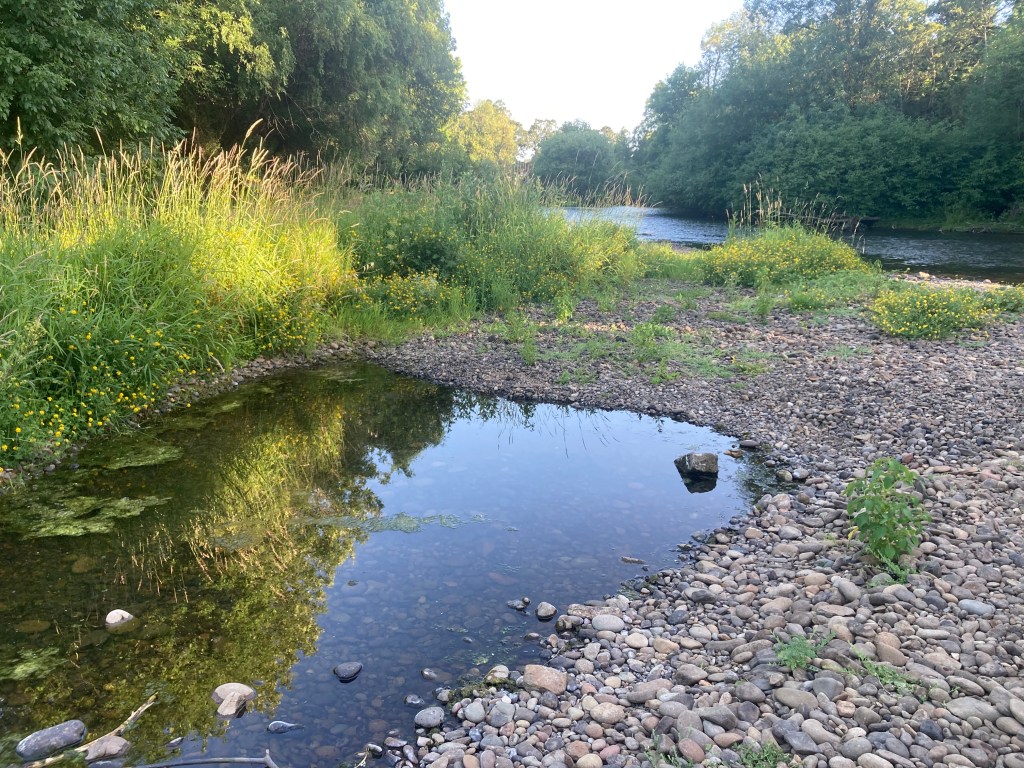
I set up my easel and my kid got busy with his net, looking for fish and tadpoles. I was about half way through my painting when my son said he was ready to go. “There’s no fish here,” he said. It was still a bit cool that morning and likely the small fish were still in deeper water. They would congregate in the warm shallows soon. I told him as much but he was unmoved. “Let’s go home,” he said. “And I’m hungry,” he added. I did my best to patiently tell him that we could go and have a snack when I was done with my painting. Grumpy, he walked over to the edge of the water and sat, staring into the water, perhaps willing the fish into his field of vision. I was close enough to being done, I realized, and I took him to find some lunch.
Being a parent is important to me and most days it is a priority. The safety and well being of my kid is something that I value above all else, and even as he becomes older and more independent, taking care of him still requires a lot of work. Parenting is wonderful and joyous but also exhausting and all consuming. I had expected to have my son accompany me on at least some of my riverside painting trips. But what I was quickly learning is that I needed to do one or the other. Trying to paint and parent at the same time means that I probably won’t be able to do either very well. It felt uncomfortable to me to be in a position where I felt like I had to directly choose between my son or my art (Are you going to feed your kid or finish this painting?). I decided I needed to plan more carefully and be more clear with myself about times when I am trying to be a painter and trying to be a dad.
Probabilistic, not Linear
From Turner, Mill Creek goes north, then west, going under the interstate and winding through the downtown area. It seemed easy enough to locate the course of Mill Creek: in Google Maps’s “satellite view” the creek’s tree lined banks make curves and loops against the strict grid of the city. I just had to find a park or other public access that seemed like a good painting spot. But that is when I noticed a small green off-shoot from Mill Creek’s path. It was the Mill Race, long ago constructed to divert water from Mill Creek to bring water power to factories downtown, like the still-standing Thomas Kay Woolen Mill. This complicated the story I was trying to tell. The water from Waln Creek didn’t follow one path, but two. A hypothetical drop of water splashing out of the culvert at Waln Creek could be taking the Mill Race route, or it could remain in Mill Creek. The path was no longer linear, but probabilistic.
I spent a lot of time exploring, trying out painting spots. First I followed the Mill Race as it follows Ferry Street through a residential neighborhood, the concrete banks of the waterway lined by houses and garages. Then I turned around and followed Mill Creek as it continues northwest through the well tended old homes of the Court-Chemeketa historical district. At Court Street an old pedestrian bridge crosses Mill Creek. I crawled underneath it, watching the dark water coiling under the bridge, but couldn’t decide on a place to paint. Another day I ordered a burrito from Habaneros on State Street and sat at the picnic table out back with my easel set up to paint the Waller Dam, the old structure that diverts water from Mill Creek into the Mill Race. There is even a Mill Race Park, a seemingly forgotten grassy area along the waterway with a bench and a fence along the waterway. On the day I went, I saw some food wrappers and a paper cup scattered in the grass. An unhoused individual was sleeping on the bench and I felt I shouldn’t interrupt their sleeping space, but I did take a quick look over the fence at the reservoir behind Waller dam, the usually fast moving water of Mill Creek backed up into a still, glassy-surfaced reservoir.
Hydrological Maze
This was a challenging area to paint, with access to the water limited and no sweeping vistas or dramatic views. I never did manage to pull off any successful paintings in this area. Things became more complicated when I spotted a second green path on the satellite view of Google Maps, branching off from Mill Creek. So the creek is actually diverted not once but twice. This additional arm of Mill Creek is known as Shelton Ditch, for reasons that seem forgotten. On the day I went to investigate, I parked in an empty lot and soon found an overgrown social trail. Could it be? Yes, this trail I needed to take was indeed lined with poison oak. Careful tiptoeing through the poison oak brought me to the edge of the ditch. Water cascaded over a dam-like structure upstream and gurgled among large boulders. I had found myself in another forgotten corner of Salem. I was drawn to the deep green color of the water as it splashed over the structure and through the dam. After quickly setting up my easel I painted as quickly and directly as I could, but this was another painting that didn’t quite resolve itself into the vision I had for it.
This was a low point in this painting project. I had to navigate a densely developed area and find public access to the creek, all while avoiding poison oak and sleeping people. And with the Mill Race and Shelton Ditch diversions, following the path of the water had become a sort of hydrological maze. In fact, I didn’t know it at the time, but there is even another ditch, the Salem Ditch, that brings water from the Santiam River to Mill Creek, farther upstream. It was originally conceived of as a project to maintain steady waterflow in Mill Creek for Salem’s factories during the low water months of the summer. The painting was challenging, too, without broad vistas or inspiring views. But I pushed on. On some level, painting comes down to a matter of quantity: the more painting I do, the greater chance of producing a successful one. With each failed painting I did, I told myself I was getting that much closer to a successful one.
The Mill Race and Shelton Ditch both connect with Pringle Creek, so despite the complexity of the route I had to explore, it did open up some additional interesting painting locations according to the criteria of my project. After Pringle Creek empties into the Willamette, the River immediately passes under the Center Street Bridge and Marion Street Bridge, with easy public access from the west bank to the gravel bars below the bridges. I did paint successfully here, multiple times, and in fact some were my favorite of the whole project, including the Willamette Queen under Center Street Bridge, a blue heron at water’s edge, and ducks in the shadow of Marion Street Bridge.

Is That Your Silver Car?
One day I brought my son with me to paint at the river at Wallace Marine Park, on the west side of the river across from downtown. I knew that this was one of the only places where I could be a dad and paint at the same time, mostly because there are ducks to feed (and chase). As soon as we parked, we were confronted by an unexpected sight: the Willamette Queen, the venerable white river boat with a giant red paddle wheel, was gliding upriver. I gathered my painting stuff and we raced down the boat ramp to the gravel bar as quickly as we could so we could watch the boat go by. Fortunately, the Willamette Queen is quite slow and we made it in time. However, as I was setting up my easel, a young couple approached me. Instantly I was on edge, remembering those living in bushes nearby and the strange people in parking lot. “Is that your silver car?” the man asked. “Because the door is open.” I was stunned for a moment before I thanked the man and jogged back to the car. I was mortified. In our haste to see the boat, not only did I forget to lock the car, I forgot to close the doors as well. Fortunately no one seemed to have noticed the unattended car apart from the young couple, and I sheepishly closed and locked the doors, grateful for the passersby’s small kindness. While the river’s public access points always seem to collect strange or marginal people, I think there is a special, primal power to the river. Just like the river gathers together water, people gather there too. Anyone can come to the river, so anyone does; there is no barrier to access. I think there is something special about this.

The gravel bar at Wallace Marine Park did in fact, end up being a good place to bring my kid along on a painting outing, because of the ducks of course. One day, an older lady who was visiting the gravel bar with her family gave my kid a nearly empty bag of Fritos so he could feed the crumbs to the ducks. He was hooked. Feeding the ducks (and then, when the food was gone, chasing them) was enough to keep him occupied for an hour, or so, long enough for a quick painting. While the Willamette Queen was moving too quickly for me to paint, I took a quick picture with my phone and used that as reference while I painted. I picked a composition that included the Willamette Queen under the Center Street Bridge, for it was interesting to me to juxtapose a more modern way of crossing the river (the bridge) with a much older version (the boat). The trick of taking a picture to freeze the one part of the composition that was moving too quickly became something I came back to several times.
Misguided Excursion
Once I made it to the Willamette River, the project became a bit easier, at least in terms of access. Public access points are numerous along the main river. I painted at Keizer Rapids park in Keizer, and at access points farther north like Wheatland Ferry, San Salvador Beach, and Butteville. While previously the water’s course resembled a maze as creeks split and combined under and between the streets of Salem, I found that now, following the water was easy: the Willamette River is one of the largest landmarks around. The challenge became distance. Public access points, while numerous, are also spread out. Scouting for painting spots wasn’t as easy as walking down the sidewalk in downtown Salem. I did a lot of scouting on Google Maps, which was somewhat useful but a poor substitute for a visit in real life.
In early summer I brought my son with me to camp at Champoeg State Park, hoping we could have some fun camping while I also did some reconnaissance for the painting project. At this point in the summer, the project felt daunting and I had to fight off bouts of self doubt. I had so much painting to do I wasn’t even sure where to start. The camping at Champoeg is fantastic at least, neatly trimmed grass under towering stately Oregon White Oaks. After getting camp set up, we followed the bike path along the river that, according to the map, goes all the way to the nearby town of Butteville. Somehow I settled on the plan of my kid riding his bike, with me jogging. The bike path winds along the river and we stopped a few times to explore side trails. At times the trail plunged into old growth groves, unexpectedly, but perhaps these were simply spots that were too steep to ever be farmed. This part of the trip was fun. And it helped that I had decided that for this trip I only had to be a dad, not a painter.
Soon, however, I heard cries of “I’m tired” coming from my kid, among the most dreaded utterances for parents everywhere. I tried patient verbal encouragement for as long as I could, before finally I offered to ride his bike myself while he walked. I didn’t honestly think he would take me up on it, but he did. I mounted the bike and began to pedal. We didn’t get very far, however, before the rear wheel loosened with my pedaling, which loosened the chain and basically rendered the bicycle unridable. I was too heavy, I realized. Now I had a tired kid and I no longer had a working human-energy-optimizing machine, AKA a bicycle. So I started walking with my grumpy child. Somehow we made it the rest of the way to Butteville. I’m not quite sure how. However, our little misguided excursion was redeemed by the fact that there appears to be only one business in Butteville and that is an ice cream shop. After a cone for each of us, our spirits were lifted, and we visited the old Butteville ferry site down by the river. There isn’t much left, but it remains a public access point for the river, which is basically a really small park with a grassy spot and a bench.
About a month later I was able to make time to return to Butteville. I climbed down to the old ferry landing, today just some jumbled slabs of concrete and some old rotten pilings. The river, mostly placid and wide, is lined with small private docks, some with small boats. Nearest to where I was standing was a private dock along with what I think was a modest house boat, almost like an apartment perhaps. A floating vacation rental it seemed. An umbrella and some Adirondack chairs were on the dock, with some towels hanging up on hooks on the exterior wall. No one was around, but the scene on the dock felt as if people would be returning any minute. However, despite the tranquil scene, the dock and the floating apartment were listing heavily to one side, almost as if sinking. This was my painting I realized: the accouterments of vacation surrounded by lines and shapes that bordered on chaos. There was something slightly humorous about the scene and while plein air landscape painting is perhaps the art form least suited to communicating humor, I try when I can.

Wild But Tame
As much as my exploration of Butteville was haphazard and unplanned, my painting excursion to Willamette Falls was the opposite. Painting the falls was one of the spots I was most excited about, but access is limited. Careful planning was required. There is a glimpse of the falls at a view point off of I-205 northbound. And there is another spot to see the falls on the Oregon City side, although the view is from above and to the side, so it largely focuses on the reservoir above the falls and the industrial ruins along the bank. My plan was to use a kayak to get the best view of the falls that I could.
I don’t own a kayak, so some research was required. I discovered a local company that offers guided kayak tours of the falls and I decided to start there. Not only am I an inexperienced kayaker, I was unfamiliar with the area. Although public access along the Willamette is plentiful, it is highly restricted at Willamette Falls. The banks of the river are private property, covered with largely abandoned industrial structures, and access to the falls itself is restricted by the Oregon Marine Board. A tour would give some good context before I tried to go there myself, and my son would be able to come along, too.
From the Oregon City marina below the falls, our small tour group paddled upstream, me in a tandem kayak with my kid. Paddling along the side of the river was encouraged, as the current is weaker. As we went, the guide, the owner of the local company, spoke enthusiastically about the river and the history of the falls. Under the Oregon City Bridge the river is at its deepest, over 100 feet deep. We crossed and paddled along the West Linn shore, stopping to peer upstream into the Willamette locks, which ferried boats around the falls beginning in 1873, although they have been shut down since 2011. The channel that the locks follow is cut into solid bedrock, and while the locks were an ambitious project in 1873, I was struck by how small they seemed. The locks were once our best effort to subvert the power of the falls, and are now abandoned and useless, at least for now.

As we approached the falls, the thundering white water came into view. It is a long horseshoe shape, made of the same ancient stubborn basalt flows that form the bluffs above us. Rather than one waterfall, it is a sort of compound waterfall, with cascades forming in many places along the precipice. If rivers serve as gathering places for both water, and people, Willamette Falls has long been the best gathering place of all, and for thousands of years people traveled to the falls and built their communities nearby. According to lore, Coyote and Meadowlark formed the falls when they dragged a cedar bark rope up the river, and releasing it, they formed a place for people to catch salmon. Public access means that anyone can come, but Willamette Falls was too valuable, and European settlers and their descendents blocked access to the falls, to use its power for their factories, mills and power plants. Along the top edge of the falls is a row of wooden boards, called flashboards, that the local power company PGE installs annually during the low flow months of the summer. I learned that Willamette Falls is technically a dam, as the flow over the falls is managed by humans through a combination of concrete structures and the flashboards. On the West Linn side of the river, PGE runs a hydropower plant. Willamette Falls is a hybrid, at once wild but tame, unruly yet managed.
I asked the tour leader about my plan to use a kayak to paint the falls, and he suggested I could set up anywhere along the river as long as there was space for my easel. And it is true: Oregon’s biggest waterways including the Willamette River are public up to the high water mark. But Willamette Falls is different. Later on in my research, an internet search turned up a map from the ODFW showing a diagonal line across the river just downstream of the falls that marks the “off-limits” area. The ODFW map it seems, is based on Oregon Administrative Rule 250-020-0032, which tells us that you are not supposed to operate a boat from the base of the falls downstream “to a line across the river” that stretches from the corner of the “West Linn Paper Company Mill A Grinder Room” to the corner of “ the previous power plant associated with the previous Blue Heron Mill on the east bank of the river as marked.” This rule was very wordy and perhaps involves a familiarity with local landmarks that is beyond all but the most committed river users. (Grinder Room? Previous power plant of previous Blue Heron Mill?) However, the ODFW map was quite clear. Access to the base of the falls is prohibited. But the inverse of this was true: all the other areas were open, at least below the high water mark. But my goal was to find a good view of the falls, not to visit the very base.
Lost to Time, or At Least To Me
A few weeks later, I was ready. I rented a high quality inflatable kayak, my kid was in summer camp and I loaded my painting gear into a dry bag. I put in a Clackamette Park, at the mouth of the Clackamas River, partly because parking by the boat ramp is ample. Once afloat, I glided silently through the clear green waters of the Clackamas, then paddled upstream the Willamette, under the I-205 bridge and to Willamette Falls. I set my easel up on the west bank of the river, at the edge of an eddy that forms when the outflow from the hydro plant rejoins the main current. The bedrock was flat here and easily accessed. I saw large fish break the surface in the eddy, although later, when a couple of fishermen in boats anchored in the eddy, they caught nothing. Painting conditions were challenging as there was no shade and I hadn’t planned for (or had room for) bringing my own source of shade. Drying times were brief and I had to paint as fast as I could. I painted my best paintings in the first couple of hours, but it had taken such effort to get to the falls, I stayed longer. Despite the challenging painting conditions, I loved it, being outside, being so close to the falls.

Later I packed up my stuff and paddled across to the east bank. This required a bit of scrambling and I had to haul my gear up to the top of rocks, about ten feet above the water. Higher up on the blocky basalt that lines the river bank, I caught a glimpse of some petroglyphs carved in the rock, their meaning lost to time, or at least to me, a weathered remnant of the people who once gathered here. Again I was painting in the direct sun, painting as quickly as possible because the paint was drying nearly as soon as it came off the brush. However, this vantage point was better, as I could see right up the horseshoe of the falls to the main cascade, sheets of mist lifting off the tumbling water and into the air.
Looking down at the water below, I was able to peer into the rushing water below. It seemed perhaps ten feet deep and I could see the gravely bottom. A few times I caught a glimpse of a fish below me and I realized it was a huge sturgeon gliding in the current. I had difficulty gauging its true size, given the angle of my perch above the river and the refractive properties of water, but I wanted to believe the fish was at least as big as my four-foot tall child.
Later when I returned to the boat ramp at Clackamette Park, an older man started chatting with me, telling me stories about the falls. He told me about a buddy of his who was at the very base of the falls collecting the lamprey that gather there in the summer. The lamprey are known to drag themselves up the vertical cliff of the falls with their teeth as they complete their ancient migration upstream. It seems the sturgeon gather there as well, and, according to the buddy, gobble up so many lamprey that they are too big to move, and you can pet them, bloated and immobile in the shallows. The tale seemed a little too fantastic to be true, but there is something unreal about the falls themselves, so I couldn’t completely discount the story.
The Remnants of the Day
My day was not over yet. The plan was to also fit in some night time painting of the Willamette in Portland that evening. By this point in the summer, I had done some painting in Portland already, but the site I picked for that night was largely based on Google Maps sleuthing and some reviews discussing the view. Peace Memorial Park was the place, tucked between the development of the Rose Quarter and the river bank. I arrived at the park right before dusk and followed the pedestrian bridge over the train tracks. The end of the bridge includes a wide spot, before stairs descend down to the Steel Bridge, and I set up my easel right in this wide spot, taking in the sweeping views of the Steel Bridge and the Portland downtown.
The evening was warm and people were out running, walking, biking, electric-scootering, along the Eastbank Esplanade, coming and going from unseen events at the Moda Center and beyond. The atmosphere was festive, as people enjoyed the summer evening. When darkness settled, a street light above flickered on, keeping my palette visible. While earlier the sun and heat had dried my paint too quickly, now in the remnants of the day, the temperature was perfect, with drying times not too short or too long.
As dusk turned to night, the proportion of people who appeared homeless increased. Of all the people out that evening, homeless people were most friendly and talked to me as I painted. One man with a tousled red beard and gentle eyes admired my work and asked if I had any extra supplies for him to paint, too. I told him I did not, but shared some paper and charcoal. He told me he was going down the stairs and closer to the river to sketch, but he would return my charcoal soon. I never did see him again, though.
By ten p.m. I completed my first painting, and immediately saw another composition. I paused for a moment, weighing the additional painting opportunity with lack of sleep, but decided now was my chance. I quickly did the second painting, with the glowing skyline of Portland at the top of the paper, and I let the color of the lights smear into the dark waters of the Willamette. I wrapped up sometime before midnight, and I loved that painting more than any I had done. Later, in the daylight, my delight with this last painting faded, its errors becoming all too clear, but the feeling of that night stayed with me, the freedom and the peace of being up late at night, all alone except the lights of the city and the dark river below slipping away towards the ocean.

The Real Thing
In the weeks that followed, I continued painting at locations farther down stream, getting closer to the ocean, little by little. I painted below St. John’s Bridge. On one overcast August morning, I made it out to paint at Kelley Point, where the Willamette meets the Columbia. I painted on Sauvie Island, too. For this trip, I tried bringing my kid with me again. We figured out the rather byzantine permitting rules, bought an online parking permit, found a parking spot at Sauvie Island Beach, and climbed the stairs to the top of the berm that hides the view of the river from the road. The Columbia is still and calm, lake-like, with families with small children spread out along the sand. It took two trips with all my painting stuff, but eventually we got set up on the beach. I got out my easel to paint and my son was so excited to be at a new and interesting place. No longer was he building models of the Columbia in the sand back home – here was the real thing.
One of my goals with this painting project was to include more figures in my paintings, both because the human presence on the river was one of the themes of this series, and also because painting figures is hard for me. Sauvie Island Beach was perfect for this. One challenge with figures is that I felt like I had to paint a dark figure against a light background, or paint a dark background, leaving the light figure outlined. Both approaches had a tendency towards overworking. One alternative I tried at Sauvie Island was to break a figure up into two or three values shapes against a mid value background. I could use the background midvalue to paint over the dark parts of the figure, but leave the light parts outlined. Then later I could use dark paint to cover the mid value to add the final touches. And it did help with overworking.
Occasionally huge commercial ships pass the beach heading either to Portland to the south or the ocean to the north. As the ships pass, the calm waters turn into huge waves. The juxtaposition of the children with waterwings in the shallows and the industrial behemoths in the channel was stark. One particularly large ship came by, piled high with red and blue multimodal containers, like a giant floating warehouse. The name of the company — SM Lines — was painted in huge block letters along the hull. The wake from the other boats had created large waves for my son to play in but these waves were truly massive and he ran out of the water and watched from a safe distance while they slammed onto the beach before gradually subsiding.

Full Sheets
After Sauvie Island I painted in a few spots farther down stream, St Helens, Rainier. But the biggest painting thrill came at Astoria. My kid was busy with summer camp again and I had a few days with nothing to do but paint. I arrived in town late afternoon, and I could already see the fog bank looming from the west. I didn’t have much time. Immediately found a spot, the public dock at the Columbia River Maritime Museum. I had long dreamed of painting a full sheet of watercolor paper (30” x 22”) en plein air, and I decided that now was my chance. I taped the sheet to the piece of thin plywood I had saved for this purpose, although the width and weight of it meant that I couldn’t use an easel. Awkwardly, I laid the paper and board combo on the ground, set up my palette and water cups on the ground nearby, and went for it. I knew I would have to paint something to the east – as that area would remain sun lit longer – so I picked the huge cargo ships as the center of the compositions, with the deep blue water as foreground. Even before I set up my gear the roiling fog bank had covered the sun. I hesitated for a moment, convinced that I was going to make a mess of the painting. But then I realized that I didn’t care. Painting big like this was so fun it didn’t matter if I made a mess. I used my 1.5 inch hake brush to lay down big loose washes and having my paper on the ground instead of an easel wasn’t nearly as bad as I thought. The bigger paper, oddly, seemed to encourage simpler compositions, and it was fun to have the space to make big loose marks.
That evening I camped at Cape Disappointment State Park on the Washington side of the river. My campsite was one among a ring of about ten campsites, set among the shore pines at the very edge of the sea. The hiss and smell of the surf permeated the air. The other sites were filled with families, the children running around playing tag in the deepening dusk. I felt a twinge of sadness to be alone among such familial happiness, such cries of joy from young voices. I could have been here with my family, with my kid. But I decided that this was my time to think and paint as much as possible, and I needed to embrace it while it lasted.
That night the fog turned into a light rain. In the morning, the rain was gone but my tent was soaked. Painting conditions appeared grim. Drizzly or cold or overcast conditions mean drying times are long. I drove to Waikiki Beach and set up on a picnic table behind piles of driftwood. I spied my composition immediately: the lighthouse on Cape Disappointment. But rather than making the lighthouse big, I made it small, with a huge looming sky, rows of shadowy spruce trees, and dark rippling waves in the foreground. After the previous day’s painting experience I felt confident to paint another full sheet. After laying down a few washes, I found the drying times to be slow but not glacially slow, so the foggy conditions were in fact amenable to watercolor painting. After about two hours, much to my surprise I had another full sheet painting.
Like So Many Toys
I felt ready to sit there at the picnic table by the driftwood all day, just watching the sky and waves and that strange little cove. But there was so much to paint still so I knew that I had to keep moving on. I didn’t go far though. I hiked up the short-but-steep trail that brings visitors right next to the lighthouse. The views here, of the mouth of the Columbia, of Astoria in the distance, were magnificent, but still fog shrouded. I had a new idea I wanted to try out, perhaps inspired by “panorama mode” on a phone camera, painting a series of paintings on 1/16th of a sheet, to recreate the movement of one’s eye across the horizon. I used half a sheet and so had eight paintings. This approach, too, felt like an acknowledgement of failure, that the view of sky and the land and the sea here is too big to fit on paper. My series of increasingly large and ambitious paintings suddenly became small, as if fractured or shattered. With enough painting practice, I was able to find the right mindset to paint outdoors on a full sheet. But painting these little ones felt so different, effortless: with just a few marks, a few layers, the small paintings were done.
As I painted many other visitors climbed the hill to the light house. Some paused to talk to me, where my easel was set up near the fence at the southern end. They asked me how long it took me to paint it, how long I have been painting, if I ever sell my work. One man asked me to excuse his French, “because that is f***ing awesome.” Another young man in a crisp blue uniform and close cropped hair walked over to inspect my painting, before announcing “Looks good!” He told me he was relieving the person stationed at the observation deck near the lighthouse – Coast Guard employees, it seemed. As he chatted with me, he had the air of someone readying for a stretch of boredom. But at the same time, I wondered if he also had instructions from his superiors to watch out for suspicious people doing suspicious things near the lighthouse, such as me. One lady who spoke with me said that her husband was a retired river pilot. And she explained how the big commercial ships wait in the river near Astoria, because that is cheaper than waiting in Portland paying high dock fees. While they’re waiting, the orientation of the ships changes with the tide, which means a seaward facing ship does not predict its future path of travel, but rather the force of the incoming tide. These massive ships twist in the water like so many toys, meticulous human engineering at the mercy of the tides.

The Land Itself Will Be Moved
I painted for another day in Astoria and by the end of it I was exhausted. But my time was up, and I had to head home. My project was done. Or at least, I had run out of free time for painting. The summer camps were over. I had to go back to work. School was starting soon. The summer weather was about to turn soon. For a while I couldn’t quite believe it: I had painted from Waln Creek to the Willamette River to the ocean. Not too long ago it had seemed impossible. Completing the project was a powerful experience: to stick with a similar subject matter for months, to tell a story not just with one painting but a whole series. I visited places I had never been before, like Butteville, Elk Rock, and Sauvie Island.
At times I thought the landscapes the water passed through are grim, the concrete barriers and trash in downtown Salem, the industrial ruins lining Willamette Falls. What was once a living waterway is trapped by the channels and culverts that guide water through Salem, the dams on the Willamette that prevent the floods that once remade the river channel every winter. But at the same time, spending so much time along the river gave me a new perspective. The culverts and dams and bridges are signs not of the water’s defeat, but of its power. Humans must accommodate the water. The Willamette River has followed its course for thousands of years, the Columbia perhaps even longer. The water has been at work long before us, set to its ancient task of going downhill, of scraping away the rocks it touches. Given long enough, the land itself will be moved, changed, washed away, as permanent as the holes a child digs in the sand.
I did make an additional trip to Astoria with my family. We camped at Fort Stevens and went down to the beach at dusk. The sun had set, the sky a brilliant orange. People gathered at the ocean’s edge, wondering at the beautiful sunset, the ephemeral moment. The wreck of the Peter Iredale was a dark silhouette against the sky, the once massive ship gradually turning to sand, rust, and water with each day. I didn’t accomplish much painting on this trip but I didn’t mind. It was a good time to be a dad.
